BCAA vs EAA: What Indian Gym-Goers Actually Need to Know
Quick answer: If you’re already hitting your daily protein target from food and a complete protein shake, a standalone BCAA or EAA product is a “nice to have,” not a must-have — no single training situation on its own creates a proven need for one. Where it’s most likely to be useful is as a convenience: an easy way to sip aminos during long or fasted sessions, or during a calorie deficit, rather than a performance or recovery upgrade. This article breaks down the actual difference between BCAAs and EAAs, who each one is for, and how to decide without the marketing noise.
What’s the actual difference between BCAA and EAA?
Your body needs 9 essential amino acids (EAAs) from food, because it can’t make them on its own. Three of those nine — Leucine, Isoleucine, and Valine — are called the Branched-Chain Amino Acids (BCAAs), and they get extra attention because Leucine in particular helps activate a cellular signal (mTOR) involved in muscle protein synthesis (Martinho et al., 2022, Nutrients).
So every BCAA is an EAA, but not every EAA is a BCAA. A BCAA-only product gives you 3 of the 9 essential aminos. A full EAA product gives you all 9. A complete protein source — whey, eggs, meat, dairy, a properly balanced plant blend — already contains all 9 EAAs, BCAAs included, in natural proportions.
That last point matters more than most marketing copy admits: if your diet and your protein shake are already giving you enough complete protein across the day, you’re already getting BCAAs and EAAs. The question isn’t “do amino acids matter” — they obviously do — it’s “do I need to buy them again, separately, on top of what I’m already eating.”
Who actually benefits from a standalone BCAA or EAA product
Based on how these supplements are actually used (not how they’re sold), here are the situations where people most often reach for a standalone amino product — and why that’s mostly about convenience, not a demonstrated edge over simply eating enough protein:
Intra-workout sipping on long or fasted sessions
During a 60–90+ minute session, or training in a fasted state, sipping a BCAA or EAA drink can be a convenient, easy-to-digest way to get some amino acids in without the heaviness of a full protein shake mid-workout. That’s a convenience, not a demonstrated performance or recovery edge over simply eating enough protein across the day — a long or fasted session doesn’t by itself create a need for a BCAA product, it just makes a quick-sipping format more practical for some people.
Training in a calorie deficit
When you’re eating less to lose fat, hitting your daily protein target matters even more than usual — it’s your main defence against losing muscle along with fat, not a BCAA product. Whether a standalone BCAA product adds real extra protection on top of already-adequate protein is genuinely unclear: a 2022 review of BCAA trials in athletes found the effects on performance and body composition inconsistent, partly because most studies didn’t track how much total protein participants were already eating (Martinho et al., 2022, Nutrients). That review looked at BCAA supplementation broadly across many products and doses, not BCAA Blast’s specific 2:1:1 ratio or serving size, so treat it as general context rather than a direct test of this product. Being in a calorie deficit doesn’t by itself create a need for extra BCAAs; what a BCAA product can offer here is convenience — an easy way to sip aminos during a fasted or longer session without a full meal mid-workout. That’s the practical logic behind pairing a BCAA product with a meal-replacement or weight-management stack: convenience and consistency, not a guarantee that it preserves muscle on its own.
Hot-climate or high-sweat training
Formulas that add Citrulline on top of the base BCAA ratio are sometimes positioned for this use case: early research suggests Citrulline may modestly increase blood flow after exercise, though the evidence is still preliminary and a measurable performance benefit hasn’t been clearly established (a 2023 trial in the Journal of the International Society of Sports Nutrition found a measurable blood-flow increase but no significant difference in performance — note that trial tested Citrulline combined with glutathione, a different combination from BCAA Blast’s own formula, so it’s supporting context rather than a direct test of this product). Taurine is included as one of the formula’s amino acids. Neither ingredient makes a BCAA product a substitute for proper hydration — in Indian summer training conditions, your normal water and electrolyte intake still does that job; a BCAA product is, at most, an addition alongside it, not a replacement for it. Training in hot weather or sweating heavily doesn’t, on its own, create a need for BCAAs — BCAA Blast isn’t an electrolyte product and doesn’t have proven heat, hydration, or sweat-related benefits.
Who probably doesn’t need a separate product
If any of these describe you, a standalone BCAA/EAA product is optional rather than necessary:
- You already hit your daily protein target through meals and a whey shake. A protein source already contains the full amino acid profile, and a 2022 evidence summary of BCAA research put it directly: BCAAs “probably don’t have utility for people already consuming adequate protein and managing training volume appropriately” (Examine.com, 2022).
- Your training sessions are under about 45–60 minutes and you’re not training fasted.
- You’re just starting out and still building consistent training and eating habits — in that case, a straightforward protein with a good amino profile (see the next section) covers more ground for less money and less complexity than adding a second product.
BCAA Blast vs a whey protein that already lists its amino content
One detail worth knowing before you buy either: not every “extra protein” purchase needs a separate amino product, because some whey formulas already report their BCAA and EAA content on the label.
Level Up Whey, for example, lists 6.9g EAA and 3.1g BCAA per 15g-protein scoop as part of its blend — so if you’re already taking a scoop of that (or any complete whey) post-workout, you’re already getting a meaningful EAA and BCAA dose alongside your protein, not instead of it.
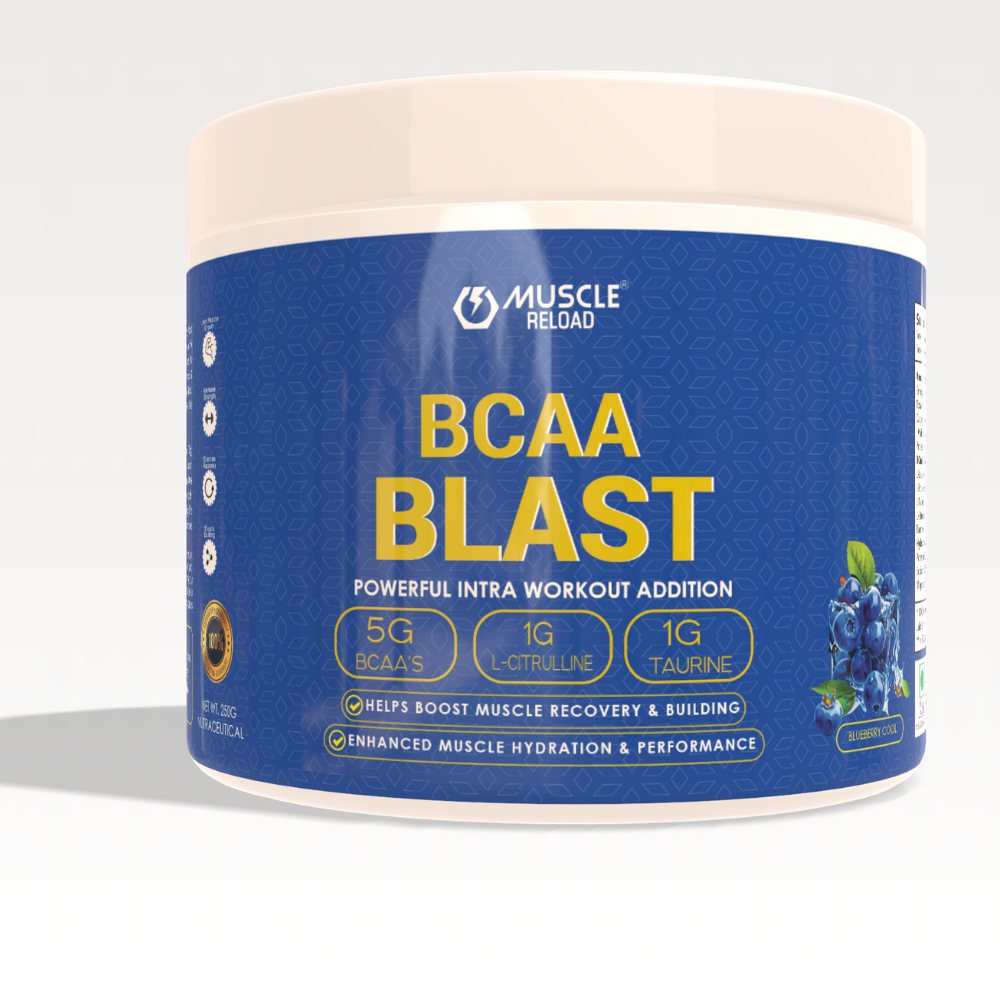
BCAA Blast, by contrast, is a standalone BCAA product: a 2:1:1 Leucine-Isoleucine-Valine ratio (2.5g Leucine per scoop), with 1g Citrulline and 1000mg Taurine added, no protein or calories, built specifically for sipping during a session rather than replacing a post-workout shake. It’s a 3-amino BCAA formula, not a full 9-amino EAA blend — useful for the intra-workout and deficit-training cases above, not a substitute for your protein intake.
| BCAA Blast | Level Up Whey | |
|---|---|---|
| What it is | Standalone BCAA (3 amino acids) + Citrulline + Taurine | Complete whey protein blend that also reports its amino content |
| Protein per serving | None — amino acids only | 15g protein per scoop |
| Amino profile | 2:1:1 BCAA ratio (2.5g Leucine), 1g Citrulline, 1000mg Taurine | 6.9g EAA + 3.1g BCAA (as part of the protein blend) |
| Best used for | Optional intra-workout amino drink; not a replacement for adequate daily protein | General post-workout or daily protein intake, beginners |
| Replaces a protein shake? | No | Yes — it is one |
A simple way to decide
If you’re not sure which situation applies to you, work through it in this order:
- Are you hitting your daily protein target from food and a protein shake? If no, fix that first — it does more for recovery and muscle than an isolated amino product ever will on its own.
- Is your training long (60+ minutes), fasted, or in a calorie deficit? None of these create a proven need for BCAAs on their own, but if you’d like an easy way to sip some aminos during the session, a standalone product like BCAA Blast is a reasonable, low-risk option to consider.
- Are you cutting calories and want a convenient way to sip aminos around training? If you already use a meal-replacement product for calorie control, BCAA Blast is a separate optional product — not a necessary addition to the stack.
- None of the above, and you just want a solid everyday protein? A complete whey that already lists a good amino profile — like Level Up Whey — covers it without adding a second product to your routine. Browse the full whey protein range if you’re still deciding which one fits.
Frequently asked questions
Is EAA better than BCAA?
Neither is universally “better” — they serve different jobs. BCAAs are 3 specific amino acids associated with triggering muscle protein synthesis; EAA products supply all 9 essential amino acids, which is closer to what a complete protein already provides. If you’re already eating enough complete protein, the practical difference between the two as an add-on is smaller than either is usually marketed to be.
Can I take BCAA and whey protein together?
Yes — they serve different moments in your day. Whey (or any complete protein) covers your overall daily intake; a BCAA product like BCAA Blast is more about convenience during the workout itself, when a full protein shake isn’t practical.
Do I need BCAA if I already eat enough protein?
Not necessarily. If your total daily protein intake is already adequate, there’s no established need for extra isolated BCAAs on top of it. Some people still choose to add them for convenience around long, fasted, or calorie-deficit training, as covered above — but that’s a personal preference, not a demonstrated requirement.
The bottom line
BCAA and EAA supplements aren’t essential for everyone, and they’re not a shortcut around eating enough protein and training consistently — adequate total protein and consistent training remain the foundation, whatever you add on top. A standalone product like BCAA Blast is best thought of as an optional convenience for specific situations — long or fasted sessions, or a calorie deficit — not a proven way to boost performance, speed recovery, or protect muscle beyond what adequate protein already does. If one of those situations describes your training and you’d like an easy way to sip aminos, it’s a reasonable, well-scoped option. If it doesn’t, a solid complete protein is doing most of the job already — see our whey protein buyer’s guide if you’re still picking one, or our whey isolate vs concentrate comparison if lactose or budget is part of your decision.
Sources consulted for the research claims above: Martinho et al., “Oral Branched-Chain Amino Acids Supplementation in Athletes: A Systematic Review,” Nutrients, 2022; Examine.com, “BCAAs: Are They Worth the Hype?,” 2022; and a 2023 randomized trial on L-citrulline and exercise blood flow in the Journal of the International Society of Sports Nutrition. Product figures (BCAA ratio, amino acid amounts, protein content) are taken directly from the current Muscle Reload product pages linked throughout.
This article is for general information and does not replace advice from a qualified nutritionist or physician, especially if you have a medical condition or are taking medication. BCAA Blast is a food supplement, not intended to diagnose, treat, cure, or prevent any disease.
Ready to Level Up Your Nutrition?
Explore lab-tested, FSSAI-approved supplements built for real results.